
After Contractor Default: Five Questions Behind a Defensible Cost-to-Complete
A contractor-default file can look deceptively simple at first: identify the unfinished work, price it, and compare the result with the contract balance. The hard part is establishing what was actually complete, what remains under the bonded scope, and what it will realistically take to finish without treating every disputed cost as settled.
For a surety claims team, the cost-to-complete estimate is a decision tool. It should be clear enough to guide the next step and traceable enough to withstand scrutiny as the record develops. These five questions help frame the first assessment.
A useful assessment separates four related components: verified work in place, remaining base-contract scope, completion premiums and schedule-driven costs, and net exposure after available contract funds and documented adjustments.
This fact base helps the claims team compare practical completion paths while bond counsel addresses notice, conditions, and legal obligations.
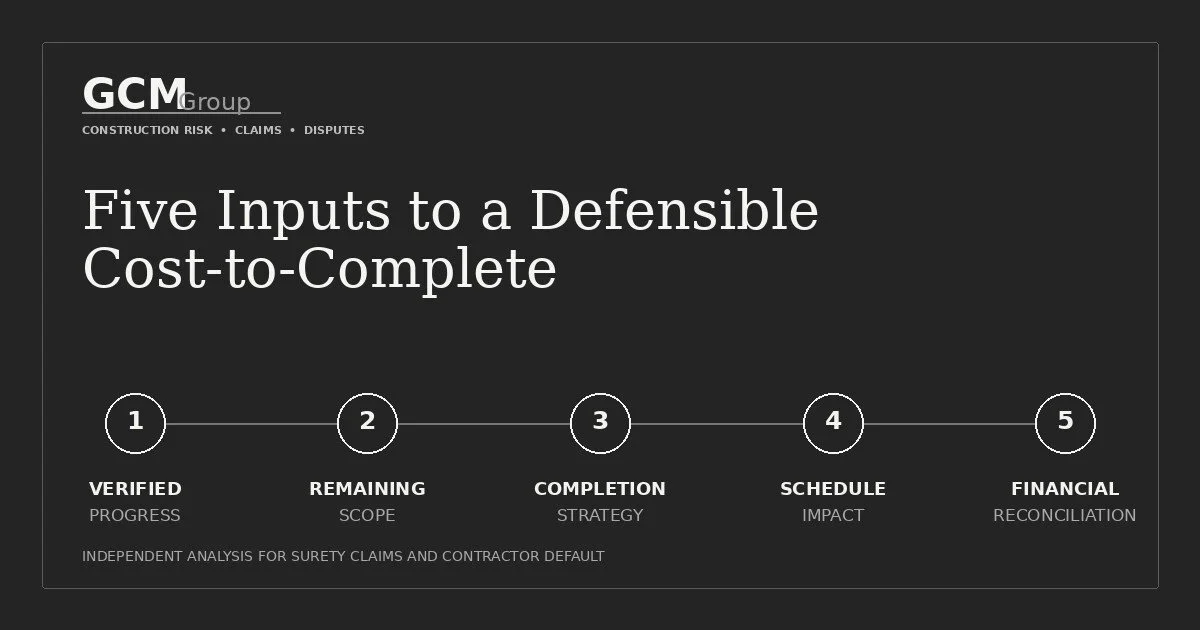
1. What work is actually complete?
Start with a dated, trade-by-trade picture of physical progress. Pay applications and a contractor’s percent-complete report are useful records, but neither substitutes for verifying installed work, stored materials, deficiencies, and work that must be removed or reworked. Tie the assessment to site observations, photographs, inspection records, schedules, and the most recent payment history. Mark what has been verified and what remains an assumption.
2. What scope remains—and how should it be classified?
The remaining-work list should distinguish original contract scope from approved changes, disputed changes, owner-directed work, and potential corrective work. That distinction matters when prices are compared and exposure is discussed. An estimate that combines contested scope with base-contract work without identifying the distinction can appear precise while answering the wrong question.
3. What will it take to restart and finish?
Completion cost is more than the value of unfinished line items. A replacement contractor may face remobilization, trade buyout, procurement gaps, site protection, temporary measures, testing, and extended project overhead. Subcontractor status and supplier commitments need to be checked. Build the estimate around a plausible completion approach, identify the pricing basis for each major component, and show a range where key inputs are still uncertain.
4. What does the schedule say about the cost?
Remaining duration affects labor efficiency, general conditions, escalation, and the feasibility of any proposed completion plan. Review the current schedule against actual progress and the critical remaining work. Separate demonstrated delay from forecast risk. A cost estimate and a schedule forecast should tell the same story about sequencing, procurement, access, and the date at which work can realistically resume.
5. Which records and decisions could change the exposure?
Reconcile the estimate with the unpaid contract balance, pending changes, payments, retainage, subcontractor claims, and known offsets, while keeping disputed amounts visible. Identify the information that could materially change the outcome: a missing subcontract, unpriced equipment, an unresolved design issue, or a schedule that has not been updated to reflect field conditions. A short list of open items is often more valuable than an unsupported single number.
Make the estimate useful before it is final
Early assessments rarely have perfect information. The useful deliverable is a dated baseline that states the scope, source documents, assumptions, exclusions, range of outcomes, and next records to obtain. As facts develop, the team can update the estimate without losing the reasoning behind the original decision.
GCM Group provides independent cost-to-complete, schedule, scope, and claims analysis for surety teams evaluating contractor default and completion options. When a matter calls for an architectural, engineering, code, or other specialist opinion, qualified professionals can join the engagement. Our work can also support expert witness and litigation needs when a dispute proceeds further.
A focused Surety Rapid Project Assessment can establish an initial fact base regarding progress, remaining scope, cost, schedule, project records, and the decisions still requiring resolution.
To discuss a distressed project, contact GCM Group at contact@globalcostmanagement.com. Bond terms, contract obligations, and legal rights should be reviewed with counsel for the specific matter.
